University of Washington · SEAL Lab

Zheng Liu

Sensing systems researcher. 7+ IEEE publications.
Leading 20 researchers as an undergraduate.

7+ IEEE Publications
3.9 GPA / 4.0
$6,500 Research Funding
20 Team Members Led
Zheng Liu

About

I am a senior undergraduate researcher in the Department of Electrical and Computer Engineering at the University of Washington, working in the Sensors, Energy, and Automation Laboratory (SEAL) under Prof. Alexander V. Mamishev. My research centers on sensing systems — designing hardware, processing signals, and extracting actionable insight across domains ranging from ionospheric detection to biomedical wearables to environmental monitoring.

As Student PI, I lead a 20-member research group and have co-authored 7+ IEEE publications, built field-deployed sensing systems, and developed classification algorithms for atmospheric phenomena. My work has been recognized with an IEEE ComSoc Worldwide Student Competition Second Prize and multiple innovation challenge awards totaling $6,500 in funding.

Education

B.S. Electrical & Computer Engineering

Minor: Experimental Physics

University of Washington

Expected: June 2026

Dean's List: 6 consecutive quarters

Research Interests

  • Sensors & Signal Processing
  • Ionospheric Sensing & Detection
  • Embedded Systems & RF Engineering
  • Communication Resilience
  • Biomedical & Environmental Sensing

Research Experience

Active Student PI
Sep 2024 – Present

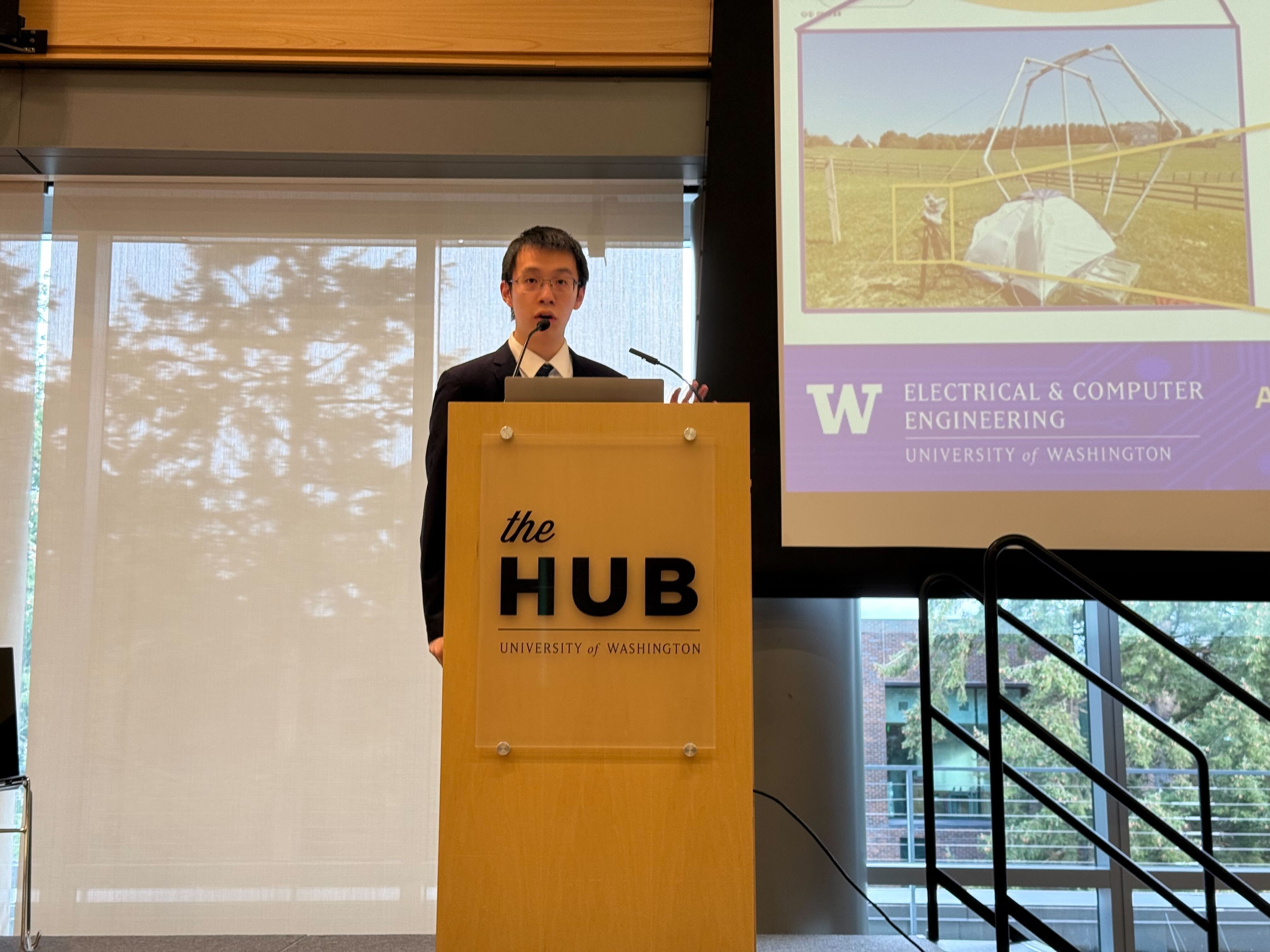
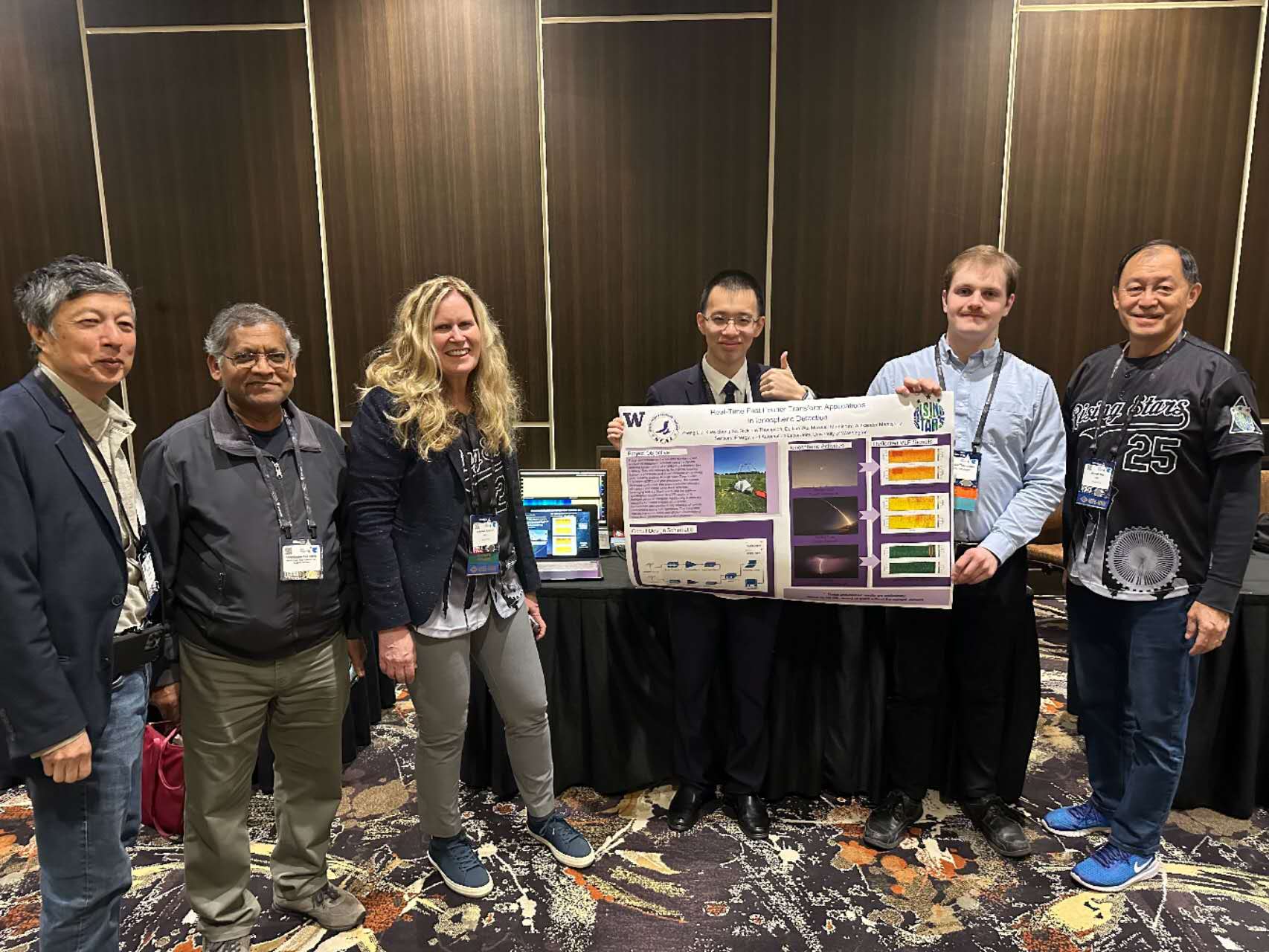
Advanced Detection of Ionospheric Disturbances Using VLF/ULF/ELF Electromagnetic Signatures

SEAL Lab, University of Washington

Role: Student PI, Project Manager, First Co-author, Hardware Engineer

Advisors: Prof. Mamishev, Prof. Makhsous, Dr. Donnangelo, Dr. Batson

Contribution Highlights

  • Designed and directed wide-band multimodal field campaigns (Perseids, Geminids) integrating embedded VLF antennas, digital magnetometers, and astronomical sky cameras; collected over 24 TB of continuous time-domain recordings.
  • Built a dual-channel high-accuracy weak-signal RF acquisition system for VLF/ULF/ELF bands with 60 dB gain, 16-bit resolution, and 500 kS/s throughput; implemented thermal regulation and EMI shielding for −20 to +80 °C deployment.
  • Developed real-time FFT/STFT pipelines with automated persistent narrowband interference removal (PNSE).
  • Led the development of Nimbusort, a spectral-morphology-based classification algorithm, distinguishing meteors, Falcon 9 launches, and space debris reentries.
  • Validated cross-instrument detections against the AMS/NASA Fireball Network, achieving >75% event match rates in blind tests.

Related Publications

  • X. Xu, Z. Liu, et al., "Automated Real-Time STFT Analysis for Persistent Narrowband Signal Emission Detection..." IEEE Signal Processing Letters [Under Review]
  • M. Mamishev and Z. Liu, "Nimbusort: Advanced Detection of Ionospheric Disturbances Using EM Signatures," IEEE MIT-URTC 2025 [Published]
Active Award Winner
2025 – Present

CommUnity: A System-of-Systems Framework for Resilient HF/NVIS Amateur Radio Communications

SEAL Lab, University of Washington

Role: Co-author, System Architect Contributor

Advisors: Prof. Mamishev, Prof. Makhsous

Contribution Highlights

  • Contributed to a system-of-systems framework integrating transient LF sensing, catalog-based event attribution, and cross-correlation with HF reception reports.
  • Won IEEE ComSoc Worldwide Student Competition Second Prize ($1,500) with this work — recognized at the international level by IEEE's Communications Society.

Related Publications

  • X. Xu, Z. Liu, et al., "CommUnity: A System-of-Systems Framework for Resilient Communication with Amateur Radios," IEEE SysCon 2026 [Under Review]
Active First Co-author
Aug 2025 – Present

Influence of Ionospheric Disturbance on Radio Propagation Integrity and Communication Resilience

SEAL Lab, University of Washington

Role: Project Manager, First Co-author

Advisors: Prof. Mamishev, Prof. Makhsous, Dr. Donnangelo, Dr. Batson

Contribution Highlights

  • Conducted database-driven HF SNR analysis by matching Perseid meteor events (IMO Fireball Database) with thousands of amateur radio reception records from the Madrigal archive.
  • Developed a geometry-aware selection algorithm using great-circle paths and distance bins to align propagation paths with meteor entry locations.
  • Applied event-locked STFT to extract ΔSNR spectrograms, followed by baseline normalization and detrending.
  • Demonstrated that individual meteor events can suppress or enhance HF link quality depending on path geometry.

Related Publications

  • X. Xu, Z. Liu, et al., "Influence of Meteor-Induced Ionospheric Disturbances on HF Radio Signal Propagation," USNC-URSI NRSM 2026 [Accepted]
Published First Co-author
Jan 2024 – Present

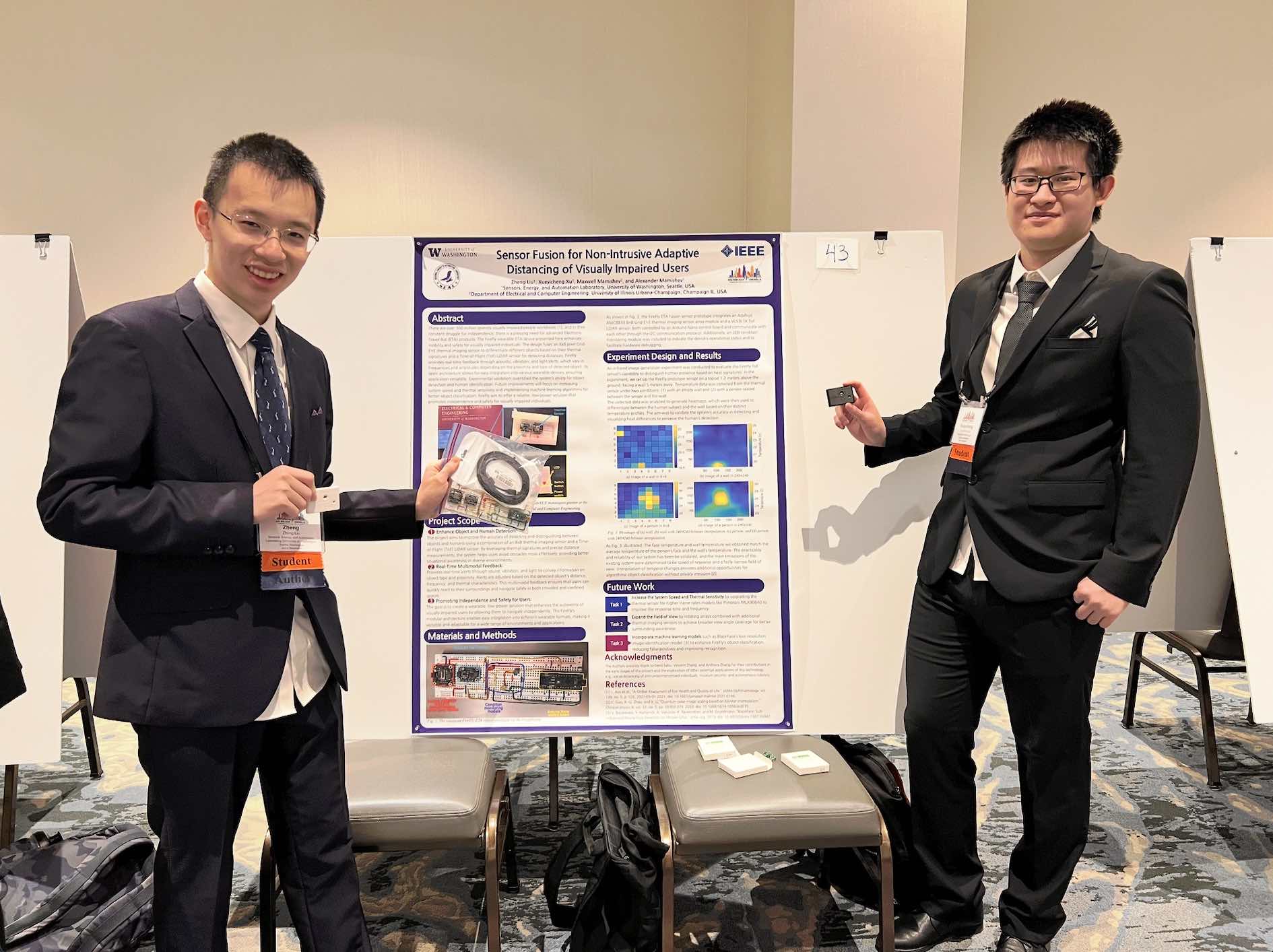
FireFly: Sensor Fusion for Non-Intrusive Adaptive Distancing of Visually Impaired Users

SEAL Lab, University of Washington

Role: Embedded Engineer, First Co-author

Advisor: Prof. Mamishev

Contribution Highlights

  • Developed the FireFly prototype, a $30 wearable Electronic Travel Aid (ETA) combining an AMG8833 thermal imaging array and VL53L1X Time-of-Flight LiDAR sensor.
  • Implemented I2C-based embedded integration on Arduino Nano with multimodal feedback (acoustic, vibration, LED) scaled to object type and proximity.
  • Designed and conducted validation experiments with bilinear interpolation (240×240 resolution) to improve classification robustness.
  • Demonstrated reliable distinction between human and non-human obstacles — validating feasibility of low-cost wearable assistive sensing for the 2.2 billion people worldwide with vision impairment.

Related Publications

  • Z. Liu, X. Xu, M. Mamishev, and A. V. Mamishev, "Sensor Fusion for Non-Intrusive Adaptive Distancing of Visually Impaired Users," IEEE BSN 2024, doi: 10.1109/BSN63547.2024.10780514. [Published]
Published
Oct 2024 – Mar 2025

Quantitative Assessment of Soldering-Induced PM2.5 Exposure Using a Distributed Sensor Network

SEAL Lab, University of Washington

Role: Project Participant, Co-author

Advisors: Prof. Makhsous, Prof. Mamishev, Mr. Nathan

Contribution Highlights

  • Optimized and deployed AeroSpec, a low-cost IoT sensor network integrating PMSA003 optical particle counters, ESP32 microcontrollers, and E-Ink displays.
  • Implemented controlled soldering trials (15 sub-trials across 4 commercial purifiers and control condition) while synchronizing six AeroSpec sensors.
  • Detected PM2.5 spikes up to 1,400 μg/m³ (93× WHO 24-hr limit); identified model-dependent purifier efficiencies.
  • Developed evidence-based guidelines for air purifier selection in instructional labs — actionable recommendations for 54,000+ U.S. electrical engineering students annually.

Related Publications

  • I. M. Kinsella, ..., Z. Liu, et al., "Quantitative Assessment of Soldering-Induced PM2.5 Exposure...," Air, vol. 3, no. 2, p. 16, 2025. [Published]
Under Review Mentor & First Co-author
Jan 2025 – Present

Comparative Assessment of PPG Signal Quality Across Fingers for Wearable Health Monitoring

SEAL Lab, University of Washington

Role: Project Mentor, Data Analyst, First Co-author

Advisors: Prof. Mamishev, Mr. Nathan

Contribution Highlights

  • Mentored a student-led team in designing a MAX30102-based PPG sensing platform with controlled data collection protocols.
  • Guided development of a signal processing pipeline with Butterworth filtering, PSD-based quality checks, and Welch's method for SNR calculation.
  • Contributed to the statistical analysis framework (RM-ANOVA, Bonferroni, Fisher's LSD) for robust validation.
  • Demonstrated that the thumb yields the highest SNR — providing sensor placement guidelines for next-generation wearable health monitoring.

Related Publications

  • K. Aleksanyan, X. Xu, Z. Liu, et al., "Comparative Assessment of PPG Signal Quality Across Fingers...," IEEE Sensors Letters [Under Review]
Under Review
2025 – Present

LOOPCAL and CAPTOR: A Calibrated Low-Frequency Sensing Framework for Outdoor Plasma Emission Detection

SEAL Lab, University of Washington

Role: Co-author

Contribution Highlights

  • Contributed to a calibration and measurement framework for detecting cold atmospheric plasma emissions in outdoor environments using low-frequency sensing.

Related Publications

  • M. Mamishev, Z. Liu, et al., "LOOPCAL and CAPTOR: A Calibrated Low-Frequency Sensing Framework...," IEEE I2MTC 2026 [Under Review]

Publications & Presentations

3 Published
1 Accepted
4 Under Review

Journal Publications

  1. I. M. Kinsella, A. N. Petrbokova, R. Yang, Z. Liu, G. Nathan, N. Thompson, A. V. Mamishev, and S. Makhsous, "Quantitative Assessment of Soldering-Induced PM2.5 Exposure Using a Distributed Sensor Network in Instructional Laboratory Settings," Air, vol. 3, no. 2, p. 16, 2025.

Conference Publications

  1. Z. Liu, X. Xu, M. Mamishev, and A. V. Mamishev, "Sensor Fusion for Non-Intrusive Adaptive Distancing of Visually Impaired Users," 2024 IEEE 20th International Conference on Body Sensor Networks (BSN), Chicago, IL, USA, 2024, pp. 1-4, doi: 10.1109/BSN63547.2024.10780514.
  2. M. Mamishev and Z. Liu, "Nimbusort: Advanced Detection of Ionospheric Disturbances Using EM Signatures," 2025 IEEE MIT Undergraduate Research Technology Conference (URTC), Cambridge, MA, USA, 2024, pp. 1-4.

Accepted

  1. X. Xu, Z. Liu, M. Yang, T. Agarwal, M. Mamishev, G. Nathan, S. Makhsous, N. Donnangelo, "Influence of Meteor-Induced Ionospheric Disturbances on HF Radio Signal Propagation," 2026 USNC-URSI National Radio Science Meeting (NRSM), Boulder, CO, USA, 2025.

Under Peer Review

  1. X. Xu, Z. Liu, M. Mamishev, H. Nakajima, T. Tusty, M. Stafford, O. Mahmoud, and S. Makhsous, "CommUnity: A System-of-Systems Framework for Resilient Communication with Amateur Radios," IEEE SysCon 2026.
  2. M. Mamishev, Z. Liu, X. Xu, W. Sun, M. Yang, and S. Makhsous, "LOOPCAL and CAPTOR: A Calibrated Low-Frequency Sensing Framework for Outdoor Detection of Cold Atmospheric Plasma Emissions," IEEE I2MTC 2026.
  3. K. Aleksanyan, X. Xu, Z. Liu, H. Lin, G. Nathan, and A. V. Mamishev, "Comparative Assessment of PPG Signal Quality Across Fingers for Wearable Health Monitoring and Implications for Sensor Design Optimization," IEEE Sensors Letters.
  4. X. Xu, Z. Liu, M. Yang, D. Muir, G. Nathan, N. Donnangelo, M. Batson, S. Makhsous, and A. V. Mamishev, "Automated Real-Time STFT Analysis for Persistent Narrowband Signal Emission Detection in Low-Frequency Spectrograms Using Interpretable Density-Based Method," IEEE Signal Processing Letters.

Awards & Scholarships

Total research funding received: $6,500

Nov 2025

IEEE ComSoc Worldwide Student Competition — Second Prize

$1,500 · International recognition for CommUnity project

Dec 2025

Environmental Innovation Challenge Prototype Funding

$1,000

Dec 2025

Hollomon Health Innovation Challenge

$2,000 · Health innovation funding for FireFly

Sep 2025

IEEE University Partnership Program — MIT-URTC Conference Travel Award

Feb 2025

SEAL Lab 2024 Featured Student

Selected as 1 of 2 featured students out of ~40 members

Jan 2025

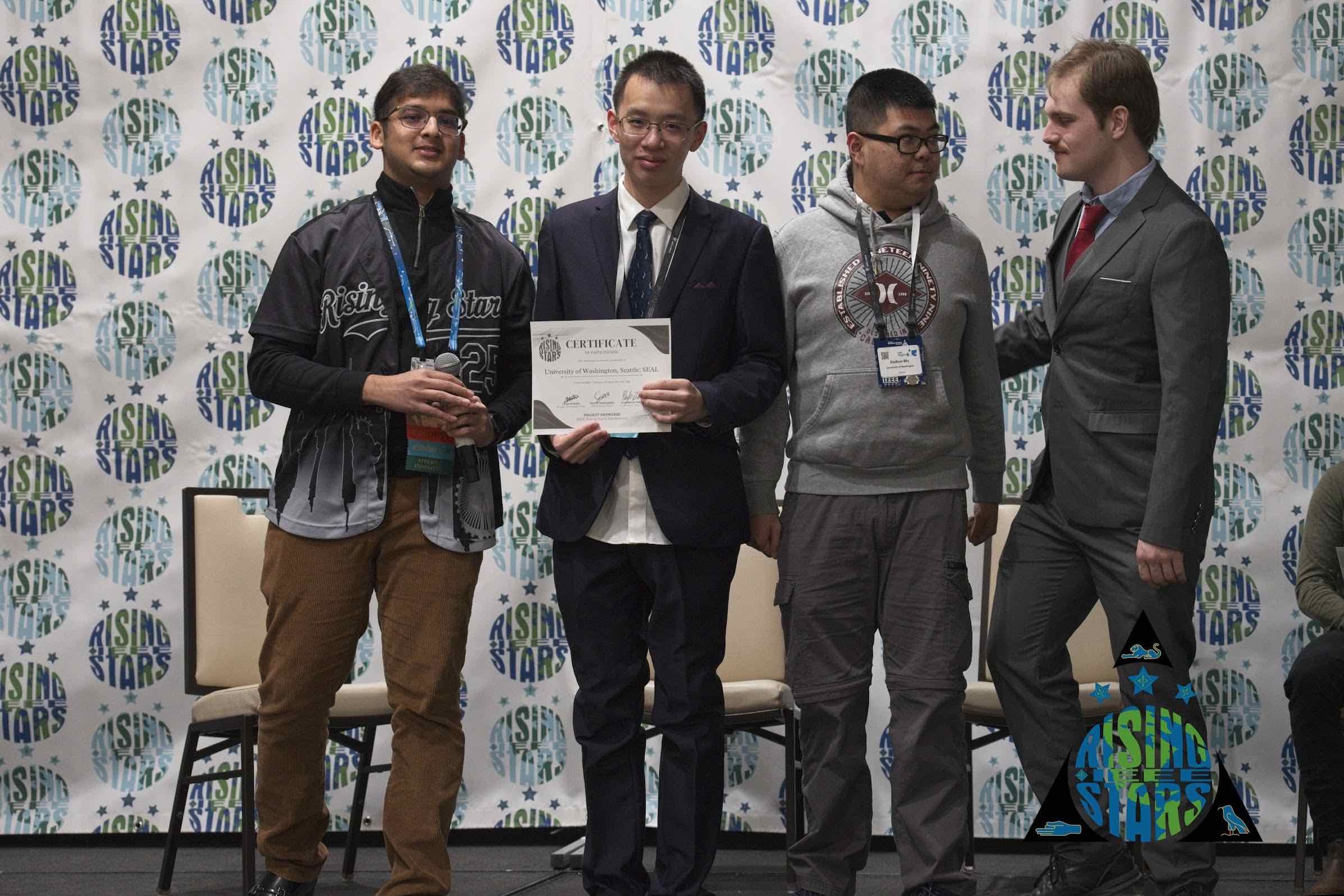
IEEE Rising Stars 2025 Conference — Project Showcase Presentation Contest

Runner-Up Presentation Award

Dec 2024

Hollomon Health Innovation Challenge Prototype Funding

$1,200

Nov 2024

IEEE Rising Stars Conference Travel Award

Oct 2024

University of Washington ECE Student Conference Travel Award

$800

Professional Experience & Leadership

Professional Experience

Project Mentor, ENGINE Capstone Program

Dec 2024 – Jun 2025

SEAL Lab, University of Washington

  • Mentored a senior capstone team on the Resilient Measurements project, focused on redesigning a dual-channel VLF ionospheric detection system for reliable long-term field deployment.
  • Guided students in system integration and testing, including amplifier/filter validation, DAQ workflows, and EMI/thermal management strategies.

Peer Reviewer, IEEE Sensors Journal

2025 – Present

Reviewed: "Machine Learning in Gas Sensing: Paradigm Shift for Enhanced Detection and Selectivity — A Review"

Peer Reviewer, IACOP 2025 Conference Proceedings

2025

Reviewed: "Adaptive Illumination Pulsed Time-of-Flight Sensor"

Leadership & Scholarly Activities

Undergraduate Research Assistant — Group Leader

Mar 2024 – Present

SEAL Lab, University of Washington

  • Led a 20-member research group focusing on innovative embedded system design and application research.
  • Coordinated research teams, scheduled events, and mentored projects to ensure effective collaboration.
  • Authored papers, proposals, and reports, and developed technical writing assistance tools.

Marketing Coordinator & Webmaster, IEEE Student Branch

Jun 2025 – Present

University of Washington

  • Secured IEEE Officer Travel Awards via the IEEE University Partnership Program.
  • Designed, coordinated, and sold custom UWECE department hoodies.

Event Planner, IEEE Student Branch

Sep 2024 – May 2025

University of Washington

  • Coordinated departmental and social events (IEEE-HKN Induction, Casino Night, HacksOne, Spring Picnic) for 50–200 participants.

Undergraduate Teaching Assistant, EE393

Dec 2023 – Mar 2024

University of Washington

  • Hosted quiz sections on technical writing; held office hours; graded homework and projects with constructive feedback.

Society & Council Memberships

IEEE Student Member 2023 – Present (3 years)
IEEE Geoscience & Remote Sensing Society 2024 – Present
IEEE Communications Society 2025 – Present
IEEE Biometrics Council 2025 – Present
IEEE Council on RFID 2025 – Present
IEEE-HKN (Eta Kappa Nu) Student Board University of Washington

Technical Skills

Embedded Systems & Hardware

C SystemVerilog Arduino KiCad LTspice Ansys HFSS Op-Amp Design Signal Conditioning Low-Noise Circuits

Software & Programming

Python Java C Git / GitHub VS Code ModelSim

Data Analysis & Scientific Computing

NumPy SciPy Matplotlib MATLAB FFT Analysis Signal Processing Calibration Pipelines

Technical Writing & Tools

LaTeX Microsoft Office Google Workspace EndNote Zotero

Multimedia & Content Creation

Premiere Pro Photoshop Audition FL Studio OBS Studio